Candlestick Forex Strategies
Candlestick analysis is an important part of technical analysis used by many Forex traders to study price movements and market behaviour.
Candlestick charts provide visual information about how currency prices change over a selected period. They help traders identify price trends, possible reversals, and areas where buying or selling pressure may be increasing.
Each candlestick represents four important prices: the opening price, highest price, lowest price, and closing price during a particular period.
Traders often study candlestick patterns alongside other technical tools, such as support and resistance levels, trendlines, and moving averages, to help evaluate potential trading opportunities.
However, candlestick patterns cannot predict future market movements with certainty. Market conditions can change unexpectedly, and every trading decision involves financial risk.
In this section, Elite Trading Academy introduces beginners to candlestick charts, common candlestick patterns, and how traders use them to analyze the Forex market.
What are Candlesticks in Forex?
What Are Candlesticks in Forex?
Candlesticks are visual tools used in technical analysis to show how the price of a currency pair changes over a specific period.
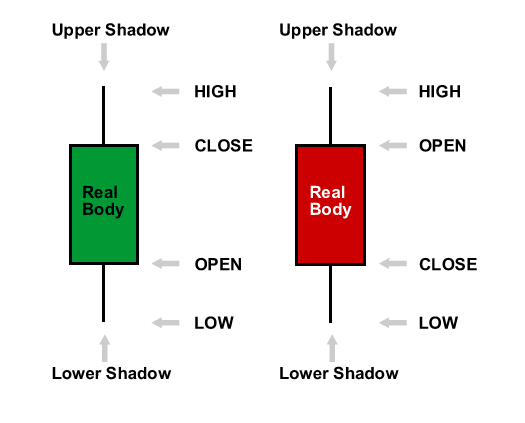
Each candlestick provides four important pieces of price information:
-
Open: The price at the beginning of the period.
-
High: The highest price reached during the period.
-
Low: The lowest price reached during the period.
-
Close: The price at the end of the period.
A candlestick can represent different timeframes, such as one minute, five minutes, one hour, one day, or one week.
Understanding the Candlestick Body
The rectangular part of a candlestick is called the real body. It shows the difference between the opening and closing prices.
A bullish candlestick forms when the closing price is higher than the opening price. It is commonly displayed in green.
A bearish candlestick forms when the closing price is lower than the opening price. It is commonly displayed in red.
Understanding Candlestick Shadows
The thin lines extending above and below the real body are called shadows or wicks.
The upper shadow shows how high the price moved during the period, while the lower shadow shows how low the price moved.
Long shadows may indicate that prices moved significantly before returning toward the opening or closing price.
Why Are Candlesticks Important?
Candlestick charts help traders observe price movements, market trends, and possible changes in buying or selling pressure.
However, candlestick patterns cannot guarantee future price movements and should be studied alongside other market information and risk-management techniques.
Red vs. Green Candlesticks
Candlesticks are commonly displayed in green and red to help traders identify price movements.
A green candlestick generally indicates that the closing price was higher than the opening price during that period.
A red candlestick generally indicates that the closing price was lower than the opening price.
Some trading platforms use different colours, such as white and black, but the underlying information remains the same.
Understanding the Length of the Real Body
The length of a candlestick's real body represents the difference between its opening and closing prices.
A long body indicates a relatively large price movement between the open and close, while a short body indicates a smaller movement.
However, a long candlestick does not guarantee that the price will continue moving in the same direction.
Understanding the Length of the Shadows
The upper and lower shadows, also called wicks, show the highest and lowest prices reached during the selected period.
A long upper shadow indicates that the price moved higher but later retreated from its highest level.
A long lower shadow indicates that the price moved lower but later recovered from its lowest level.
Shadows can provide useful information about price behaviour, but they do not reveal the exact number of buyers or sellers.
Understanding Price Movements with Candlestick Patterns
Now that you understand the basic structure of candlesticks, the next step is learning how traders use candlestick patterns to study price movements.
Candlestick patterns can provide clues about market sentiment, buying and selling pressure, and possible changes in price direction. However, they cannot predict future market movements with certainty.
Two Common Candlestick Patterns
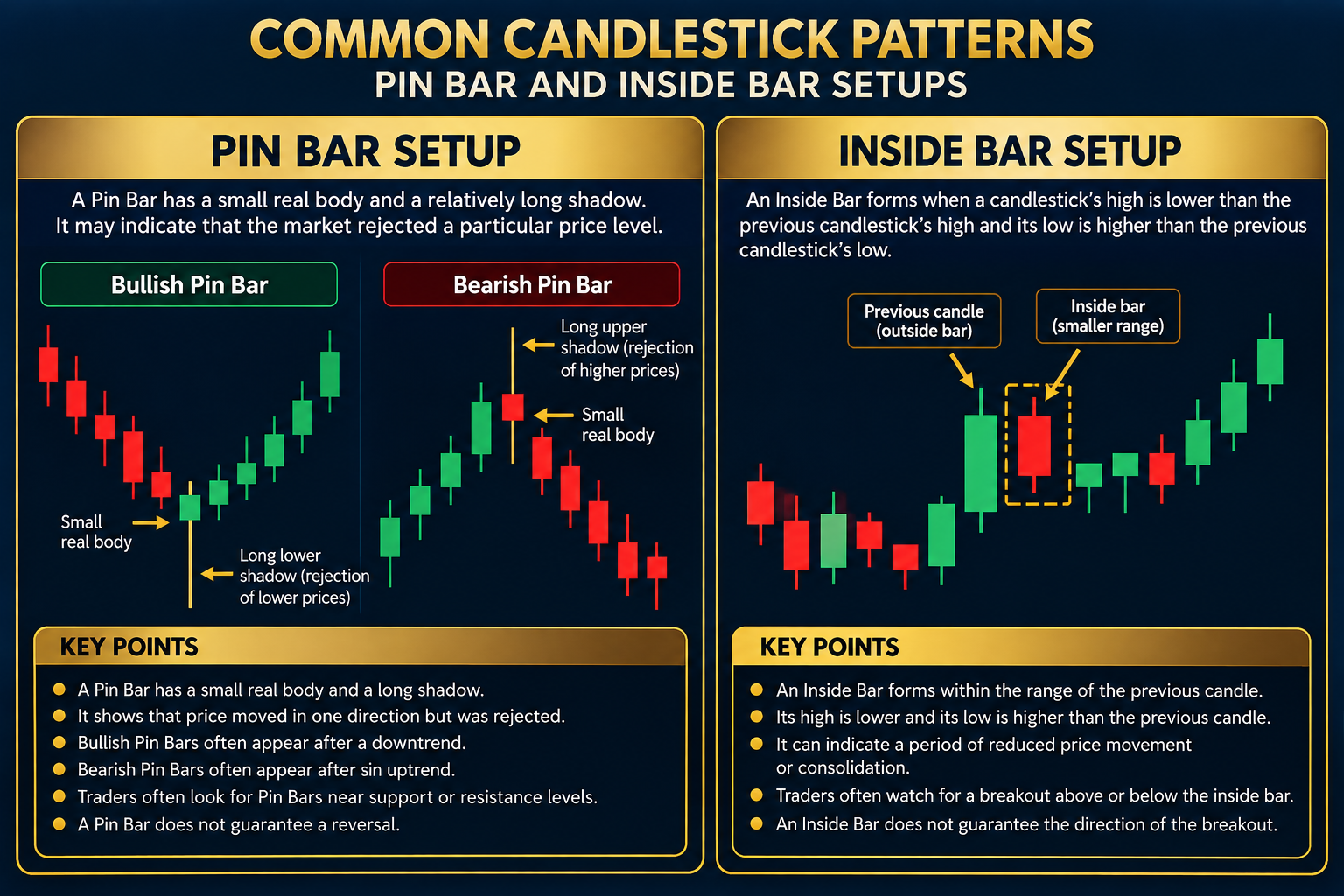
1. Pin Bar
A Pin Bar is a candlestick with a small real body and a relatively long shadow. It may indicate that the market rejected a particular price level.
Traders sometimes study Pin Bars near support or resistance levels to identify possible changes in market direction.
2. Inside Bar
An Inside Bar forms when a candlestick's high is lower than the previous candlestick's high and its low is higher than the previous candlestick's low.
This pattern may indicate a period of reduced price movement or market consolidation.
Traders sometimes monitor Inside Bars for potential breakouts, but breakouts can fail.
Practising Candlestick Analysis
At Elite Trading Academy, we encourage beginners to study candlestick patterns on historical charts and practise identifying them using a demo trading account.
Candlestick analysis should be combined with risk management and other forms of market analysis.
Important: No candlestick pattern or trading strategy guarantees profits. Forex trading involves financial risk.