Forex Trading Basics
Welcome to Forex Trading Basics at Elite Trading Academy!
This section introduces you to the fundamentals of the foreign exchange (Forex) market. You'll learn what Forex trading is, how currency pairs work, why exchange rates change, and how traders participate in the global currency market.
Our goal is to help beginners build a solid understanding of Forex trading through clear explanations and practical education.
No previous trading experience is required to begin learning. However, Forex trading involves financial risk, and profits are never guaranteed.
What is the Forex market?
The foreign exchange market, commonly known as Forex or FX, is the global financial market where currencies are bought and sold.
Forex trading involves exchanging one currency for another. Banks, businesses, financial institutions, governments, and individual traders participate in this market for different reasons, including international trade, investment, and speculation.
Unlike a traditional stock exchange, Forex operates mainly through a worldwide network of banks, financial institutions, and electronic trading platforms.
The Forex market operates 24 hours a day, five days a week, making it accessible to traders across different time zones.
Understanding Currency Pairs
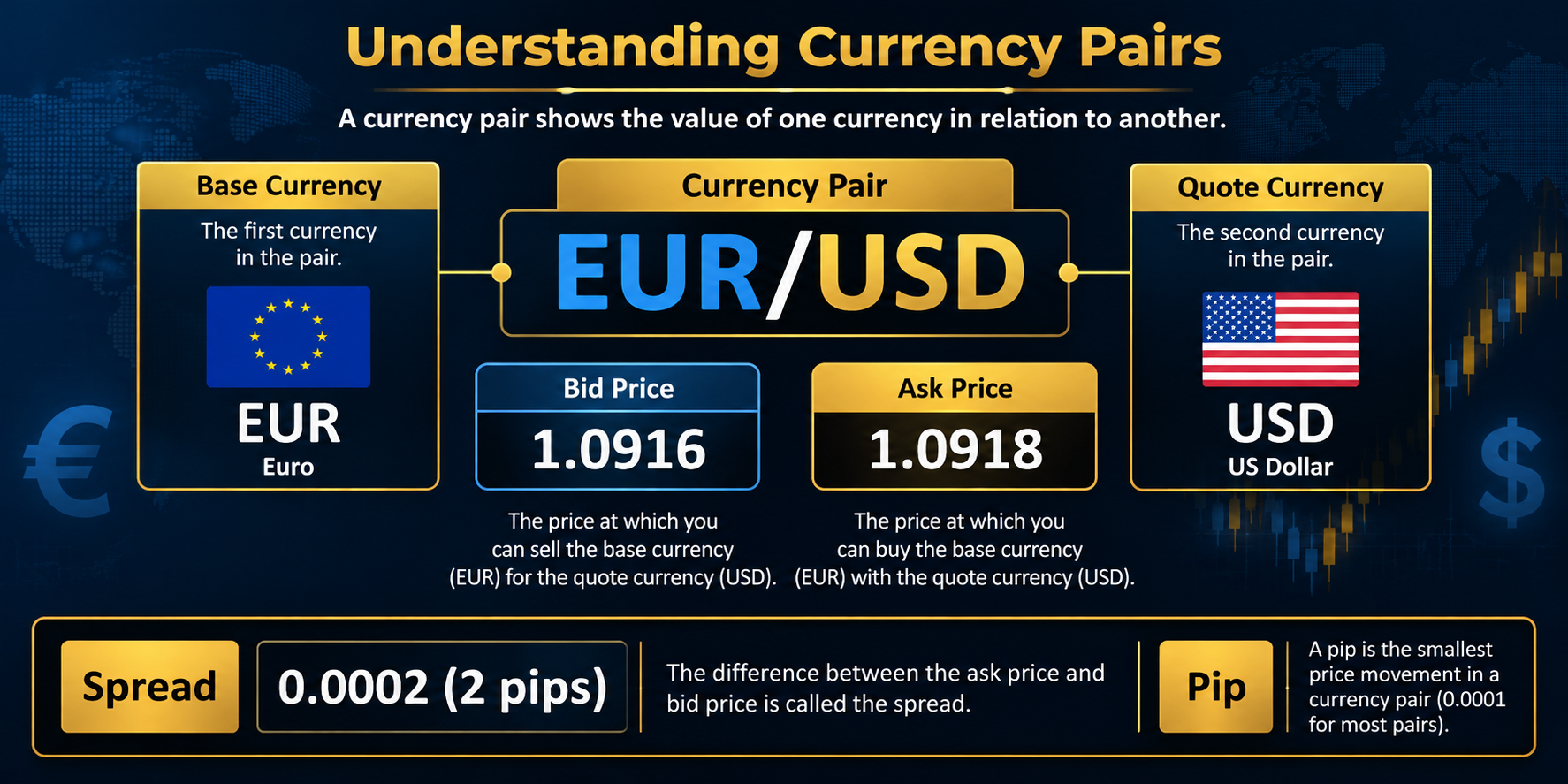
In Forex trading, currencies are traded in pairs. Each currency pair consists of two currencies: the base currency and the quote currency.
For example, in EUR/USD, the euro (EUR) is the base currency and the US dollar (USD) is the quote currency.
If EUR/USD is quoted at 1.0916, this means that one euro is worth 1.0916 US dollars.
Currency pairs have two prices: the bid price (the price at which you can sell the base currency) and the ask price (the price at which you can buy the base currency). The difference between these prices is called the spread.
PIPS
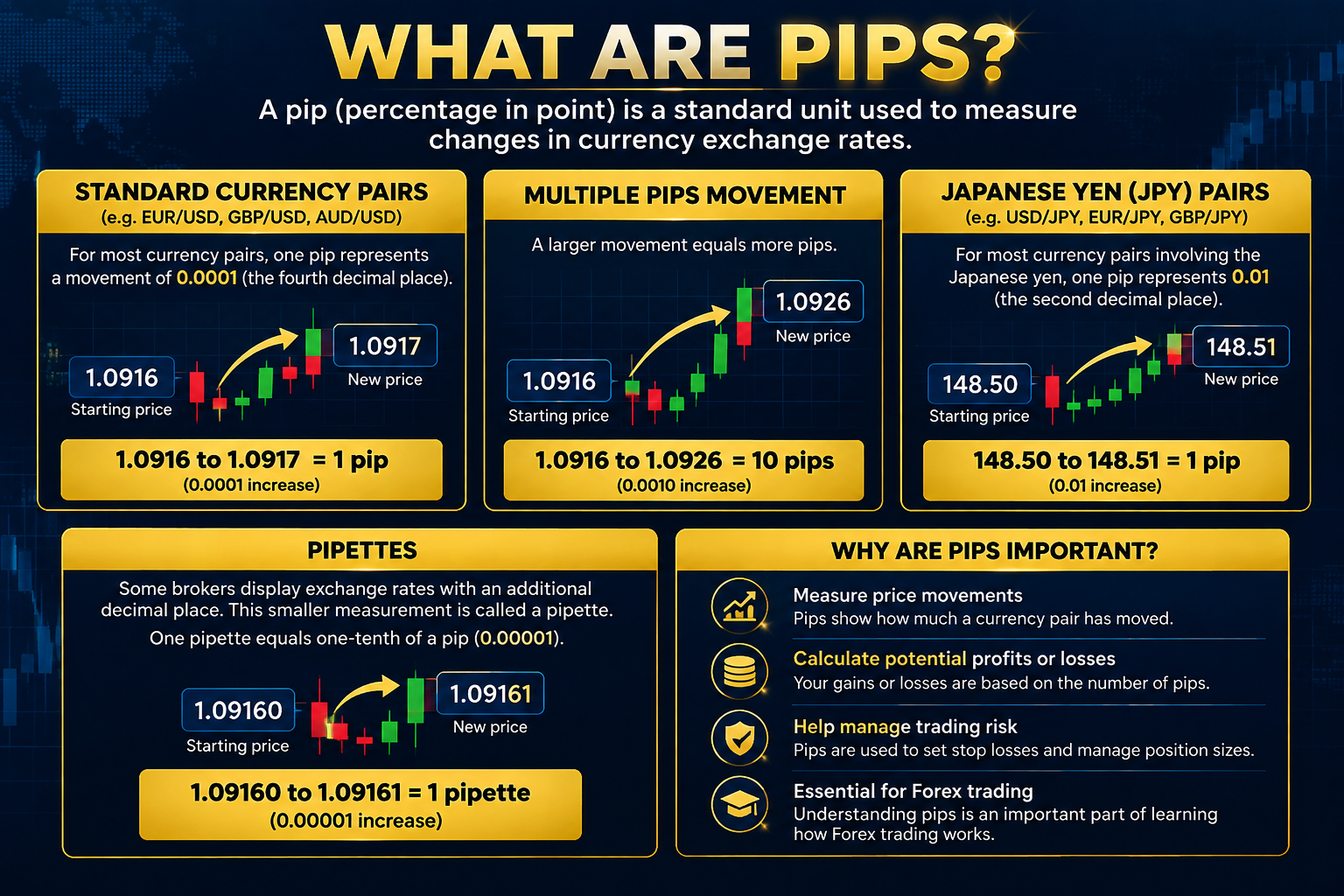
A pip stands for "percentage in point" and is a standard unit used to measure changes in currency exchange rates.
For most currency pairs, one pip represents a movement of 0.0001, which is the fourth decimal place.
Example:
If EUR/USD moves from 1.0916 to 1.0917, the exchange rate has increased by 0.0001, or 1 pip.
If EUR/USD moves from 1.0916 to 1.0926, the exchange rate has increased by 10 pips.
Japanese Yen (JPY) Pairs
For most currency pairs involving the Japanese yen, one pip represents 0.01, which is the second decimal place.
What is a Pipette?
Some brokers display exchange rates with an additional decimal place. This smaller measurement is called a pipette.
One pipette equals one-tenth of a pip.
For example, a movement in EUR/USD from 1.09160 to 1.09161 equals one pipette.
Why Are Pips Important?
Traders use pips to measure price movements, calculate potential profits or losses, and help manage trading risk.
Understanding pips is an important part of learning how Forex trading works.
CURRENCY TRADES
Trades & Key Terminology
Understanding Forex Trades: Buying and Selling
In Forex trading, traders can take two types of positions: a long position (buy) or a short position (sell).
1. Long Position (BUY)
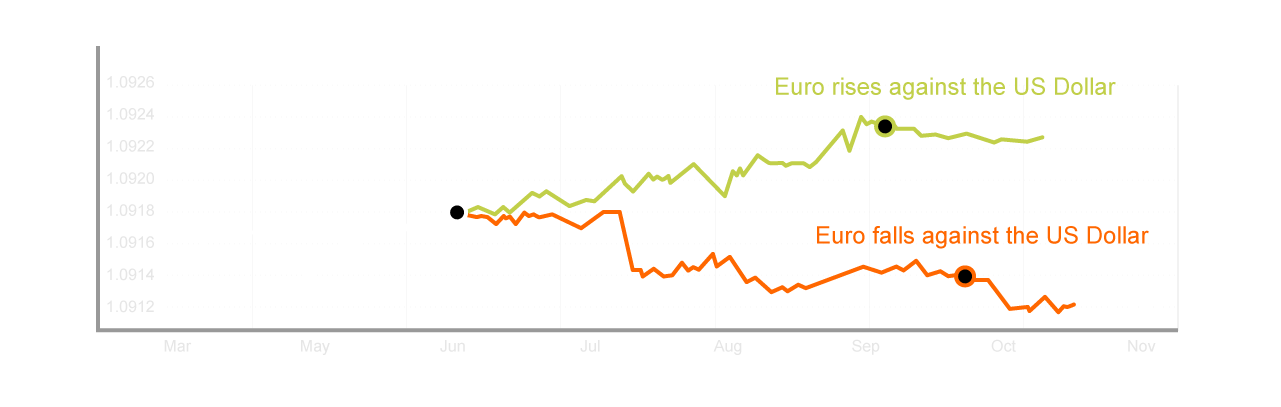
A long position means buying a currency pair because you expect its exchange rate to rise.
For example, if you buy EUR/USD at 1.0916 and the price rises to 1.0966, the market has moved 50 pips in your favour.
However, if the price falls instead, the trade may result in a loss.
2. Short Position (SELL)
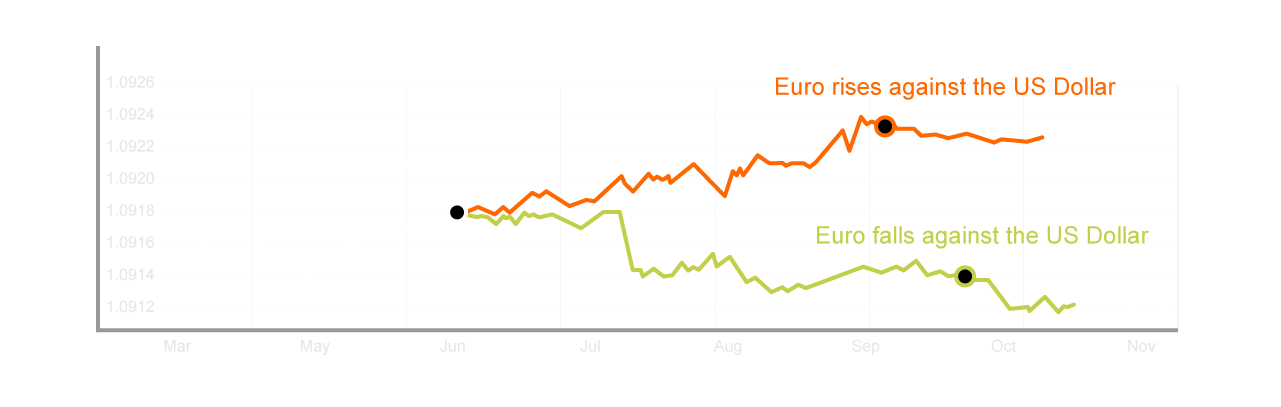
A short position means selling a currency pair because you expect its exchange rate to fall.
For example, if you sell EUR/USD at 1.0916 and the price falls to 1.0866, the market has moved 50 pips in your favour.
If the price rises instead, the trade may result in a loss.
Important: Forex traders can potentially profit from rising or falling exchange rates, but both buying and selling involve financial risk. Actual profits and losses depend on trade size, spreads, fees, and other factors.
Below is an example of EUR/USD - Short Position
Below is an example of EUR/USD - Long Position
What are the most traded currency pairs on the Forex Market?
Currencies are traded in pairs, and some currency pairs are traded more frequently than others.
Forex currency pairs are generally divided into three categories: major pairs, cross pairs (also called minor pairs), and exotic pairs.
Major Pairs
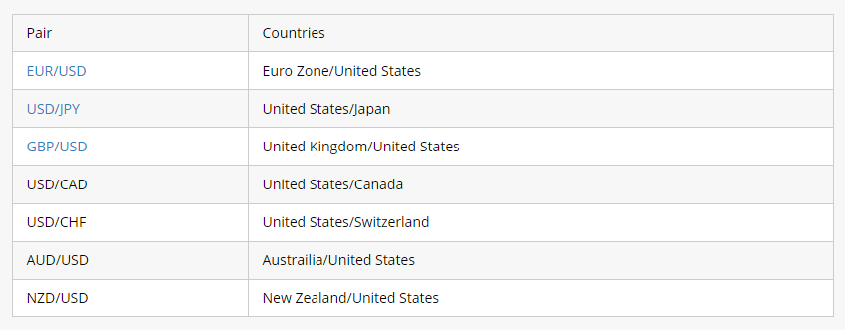
Major currency pairs are among the most actively traded pairs in the Forex market. They all include the US dollar (USD) paired with another widely traded currency.
Because major pairs generally have high trading activity and liquidity, they often have narrower spreads than less frequently traded currency pairs. However, their prices can still change rapidly, especially during major economic announcements.
EUR/USD (Euro/US Dollar) is one of the most actively traded currency pairs in the world.
The table below shows seven commonly recognised major currency pairs.
CROSSES
Cross currency pairs, also called minor pairs, are Forex currency pairs that do not include the US dollar (USD).
Examples include EUR/GBP (Euro/British Pound), EUR/JPY (Euro/Japanese Yen), and GBP/JPY (British Pound/Japanese Yen).
Some cross currency pairs are actively traded and have good liquidity, while others have wider spreads and lower trading volumes than major currency pairs.
EXOTIC PAIRS
Exotic currency pairs generally combine a widely traded currency, such as the US dollar or euro, with the currency of an emerging or smaller economy.
Examples include USD/ZAR (US Dollar/South African Rand), USD/MXN (US Dollar/Mexican Peso), and USD/TRY (US Dollar/Turkish Lira).
Exotic pairs often have lower liquidity, wider spreads, and potentially greater price volatility than major currency pairs.
Beginners should understand these differences and the risks involved before considering trading exotic currency pairs.
Can Small / Medium Traders Actually Trade Forex?

Can Beginners Trade Forex with a Small Account?
Yes. Individuals can participate in the Forex market, and some brokers offer accounts with relatively low minimum deposits.
However, the amount required to open an account is different from the amount needed to manage trading risks responsibly.
Can You Start with $100?
Some brokers allow traders to open accounts with $100 or less. However, trading with a small balance can be challenging because spreads, trading costs, leverage, and market movements can significantly affect the account.
A small account does not guarantee small losses, particularly when leverage is involved.
What Should Beginners Do First?
At Elite Trading Academy, we encourage beginners to focus on education before risking real money.
Start by understanding how the Forex market works, learning about currency pairs, practising on a demo account, and developing sound risk-management habits.
Remember: Forex trading involves substantial financial risk. You can lose some or all of the money you deposit, and profits are never guaranteed.
Is Forex Trading a Scam?
Forex trading itself is a legitimate financial activity involving the buying and selling of currencies. Banks, businesses, financial institutions, and individual traders participate in the global Forex market.
However, fraudulent schemes and dishonest operators do exist within the Forex industry. Beginners should learn how to recognize potential scams before depositing money or opening a trading account.
Warning Signs to Watch For
-
Promises of guaranteed profits or risk-free trading.
-
Claims that you can become wealthy quickly with little effort.
-
Pressure to deposit money immediately.
-
Individuals or companies unwilling to provide clear information about their business or regulatory status.
-
Requests to send trading funds directly to someone's personal account.
-
Difficulty withdrawing funds or unexplained withdrawal fees.
How Can You Protect Yourself?
Before choosing a Forex broker, research the company, check its regulatory status with the relevant financial authority, and understand its fees and trading conditions.
Never invest money you cannot afford to lose.
At Elite Trading Academy, our focus is on Forex education, helping beginners understand the market, trading terminology, and responsible risk management.
Remember: Even when using a legitimate broker, Forex trading carries substantial financial risk, and profits are never guaranteed.
Risk and Money Management
One of the most important skills in Forex trading is learning how to manage your trading capital and control financial risk.
Even experienced traders experience losses. Effective risk management helps traders make more disciplined decisions and reduce the possibility of significant financial losses.
Important Risk Management Principles
-
Trade only with money you can afford to lose. Never use funds needed for essential living expenses.
-
Understand leverage. Leverage can increase both potential profits and potential losses.
-
Use appropriate position sizes. The size of each trade should reflect your account balance and risk tolerance.
-
Understand stop-loss orders. These can help limit losses, although they do not guarantee an exact exit price.
-
Avoid emotional trading. Fear, excitement, and frustration can lead to poor decisions.
-
Practise with a demo account. Learn how trading platforms work before risking real money.
Remember: Good risk management cannot eliminate trading losses, but it is an essential part of responsible Forex trading.
Analyzing markets and news
Analyzing Markets and News
Understanding financial markets involves learning how economic events, news announcements, and global developments can influence currency prices.
Forex traders often use two main approaches to study the market:
1. Fundamental Analysis
Fundamental analysis involves examining economic and financial information that may influence the value of a currency.
Important factors include:
-
Central bank interest-rate decisions
-
Inflation reports
-
Employment and unemployment figures
-
Economic growth reports
-
Political and geopolitical developments
For example, an unexpected interest-rate announcement by the US Federal Reserve may affect the value of the US dollar against other currencies.
2. Technical Analysis
Technical analysis involves studying price charts, historical market movements, trends, and technical indicators to identify possible trading opportunities.
Traders may use tools such as support and resistance levels, moving averages, and candlestick patterns.
However, technical analysis cannot predict future prices with certainty.
Paying Attention to Major Economic Events
Major economic announcements can cause rapid movements in currency prices. These movements may create trading opportunities, but they can also increase volatility, spreads, and the risk of financial losses.
Beginners should learn how to use an economic calendar to identify upcoming announcements and understand their potential impact on the Forex market.
Developing a Responsible Trading Approach
Successful risk management requires patience, discipline, ongoing education, and an understanding that market conditions can change unexpectedly.
At Elite Trading Academy, we encourage students to practise with demo accounts, study market behaviour, and develop responsible trading habits before risking real money.
Important: No trading strategy or market analysis guarantees profits. Forex trading involves substantial financial risk.
Resources
Helpful Forex Learning Resources
The following websites provide financial news, economic calendars, and educational information that can help beginners learn more about the Forex market.
MarketWatch – Financial news and market developments.
https://www.marketwatch.com
Forex Factory – Economic calendar, market news, and Forex discussions.
https://www.forexfactory.com
BabyPips School of Pipsology – Beginner-friendly lessons covering Forex terminology, trading concepts, and risk management.
https://www.babypips.com/learn/forex
Important: These websites are independent educational resources. Elite Trading Academy does not guarantee the accuracy of third-party information or endorse any particular trading strategy.